
The Silent Stitch: The Secret of 42 Willow Lane
9/17/20255 min read
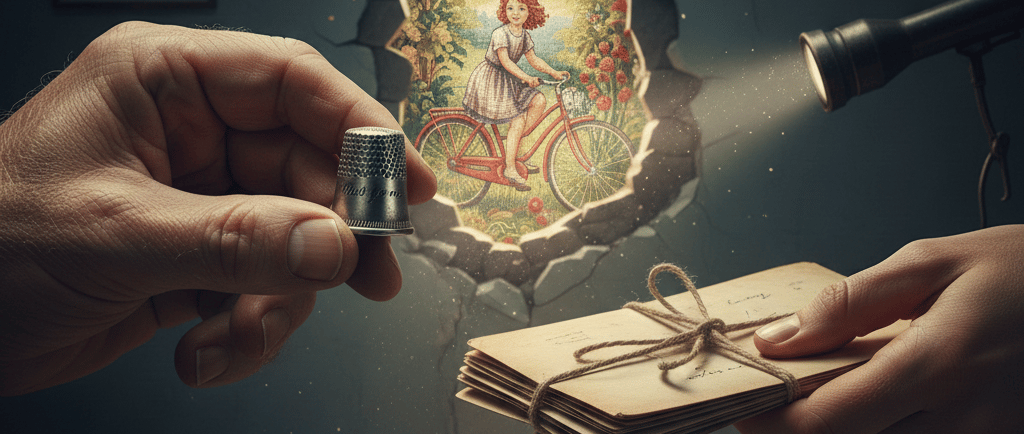
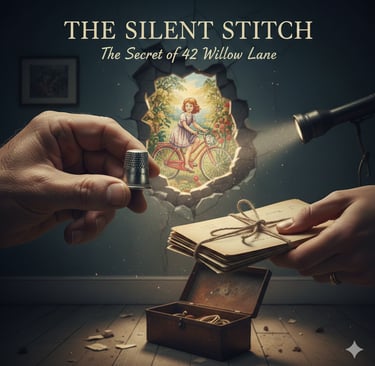
They tell you that when you buy an old house, you aren't just buying wood and brick; you’re buying the echoes of everyone who ever called it home. But when I signed the deed for 42 Willow Lane, I wasn't looking for ghosts. I was looking for a fresh start.
The house was a Victorian "fixer-upper" that had belonged to Clara Vance, a woman the town remembered only as a recluse. "Clutching Clara," the local kids called her, because she was always seen holding her right hand tight against her chest, as if guarding a diamond.
She had died at ninety-two, alone, leaving behind a house frozen in 1964.
The Discovery
Three weeks into the renovation, I was pulling up the water-damaged floorboards in the smallest bedroom—the one that would eventually be a nursery for the baby I was expecting in the fall.
My crowbar hit something that didn’t sound like wood. It sounded like hollow metal.
Beneath the joists sat a small, fireproof iron box. My heart hammered against my ribs. Treasure? Deeds? I pried it open. Inside was a tattered blue velvet pouch and a stack of letters tied with a simple kitchen twine.
Inside the pouch wasn't a diamond. It was a silver thimble.
It was tiny, tarnished, and seemingly worthless. But as I picked it up, I noticed something strange. The tip of the thimble was dented—not from a fall, but from thousands of hours of pressure. And engraved inside the rim, in microscopic script, were three words: “Wait for me.”
The Letters of the Ghost
I spent the night on the dusty floor, reading Clara’s letters. They weren't addressed to a lover or a husband. They were addressed to "The Little Bird."
October 14, 1961: My darling Little Bird, today I stitched the first row of your blanket. They say I must let you go, but my needle says otherwise. Every stitch is a prayer. Every knot is a promise.
As I read on, the "plot" of Clara's life began to unravel. The town thought she was a bitter woman who hated children. The truth was far more devastating. Clara had been a master seamstress for the wealthy families on the hill. In 1961, she had a daughter—a "Little Bird" born with a heart too weak for the world.
The letters described a desperate mother who believed in a folk legend: The Shroud of Seconds. The legend claimed that if a mother could sew a garment of a million stitches, each one infused with a specific memory of love, time itself would pause its pursuit of the child.
The First Twist: The Madness of Love
For three years, Clara didn’t leave the house. She sewed. She sewed day and night, her fingers bleeding into the silk. The neighbors saw her through the window, hunched over, moving her hand rhythmically. They thought she was counting gold. They thought she was hoarding.
But then, the letters stopped in 1964. The last one was tear-stained and frantic:
“The thread has run out. They are coming for you today. I have hidden the evidence of our time. If I cannot keep you in this world, I will keep you in the walls of this house.”
I felt a chill. I looked at the walls of the nursery. Was Clara Vance a murderer? Had she hidden her child’s remains behind the plaster? The viral "true crime" theories started racing through my mind. I reached for my phone to call the police, but my hand brushed the silver thimble again.
I realized something. The thimble wasn't just dented. It was worn through.
The Second Twist: The Hidden Room
I grabbed a hammer. If there was a secret in these walls, I had to know before my own child slept here. I began tapping the plaster near the window. Thump. Thump. Hollow.
I swung. The plaster gave way, revealing not a gruesome secret, but a void. I tore away the lath, and my flashlight beam cut through the darkness.
It wasn't a grave. It was a masterpiece.
Behind the false wall was a "shadow room"—a tiny, perfectly preserved space filled with hundreds of hand-sewn tapestries. They covered every inch of the wall. They weren't just patterns; they were portraits. Every single one depicted a young girl growing up.
In one, she was five, riding a bicycle. In another, she was sixteen, wearing a prom dress. In the final one, she was a woman in a wedding gown.
But here was the twist: Clara’s daughter had died in 1964. The town records confirmed it. These tapestries were dated after her death.
Clara hadn't been sewing to save a life. She had been sewing a future that never happened. She had lived an entire second life in her head, stitch by stitch, for fifty years. Every "millionth stitch" was a birthday she never got to celebrate.
The Ending That Changes Everything
I sat in that hidden room, surrounded by the ghosts of a life that wasn't lived, feeling a profound sense of pity for the "Crazy Clara" the town had mocked. I felt the weight of her loneliness.
But then, I saw the final piece of paper at the bottom of the iron box. It wasn't a letter. It was a legal document from a law firm in London, dated only two years ago.
It was a trust fund activation.
The document stated: “To be released to the occupant of 42 Willow Lane upon the discovery of the Silver Thimble.” Attached was a photograph.
It was a photo of a woman in her thirties. She was standing in a garden in England, holding a young boy. On her finger, she wore a matching silver thimble.
The letter attached read: “My mother, Clara, knew she couldn't keep me safe in that town. The scandal of my birth and my illness would have seen me institutionalized. She didn't sew a shroud. She sewed a fortune. She sold her masterworks secretly to collectors in Europe to pay for my surgery and my escape. She stayed behind to play the 'madwoman' so no one would ever look for me. She sacrificed her reputation and her sanity so I could grow up in secret, far away from the prying eyes that wanted to take me from her. I am the Little Bird. And I am finally coming home.”
The woman in the photo was the spitting image of the girl in the tapestries. Clara Vance wasn't a recluse who lost her mind. She was a genius who played a fifty-year game of chess against a judgmental world—and she won.
I looked down at the silver thimble in my hand. It wasn't a relic of madness. It was a badge of the most fierce, quiet bravery I had ever known.
I'm not changing a thing in the nursery. I’m going to finish the tapestries. Because at 42 Willow Lane, love doesn't just live in the heart. It lives in the walls.